
Bilona Cow Ghee vs Regular Ghee: 7 Proven Differences, Health Benefits, and Purity Tests
✨ Key Takeaways for Quick Reading
- Bilona cow ghee is crafted from whole curd churned bi-directionally, whereas regular industrial ghee is made by skimming raw cream using mechanical separators.
- Slow low-flame simmering protects natural butyrate, fat-soluble vitamins (A, D, E, K2), and delicate omega fatty acids from heat damage.
- Natural cultured fermentation digests milk proteins and lactose, making traditional curd-churned ghee exceptionally easy on sensitive stomachs.
- Authentic bilona ghee displays a natural golden grain (danedar texture) and a comforting nutty aroma without synthetic fragrances or stabilizers.
- Testing ghee at home with heat, refrigeration, and iodine helps detect adulteration, while NABL certified RM values verify pure cow milk fat.
Pure cow ghee has anchored Indian culinary heritage and Ayurvedic wellness for thousands of years.
Yet walk down any supermarket aisle today, and you will see dozens of jars labelled simply as pure ghee.
Behind those labels lie two completely different foods produced through fundamentally contrasting processes.
Understanding whether your ghee comes from cultured whole milk or industrial cream separation changes everything from digestion to daily nutritional value.
What is Traditional Bilona Cow Ghee?
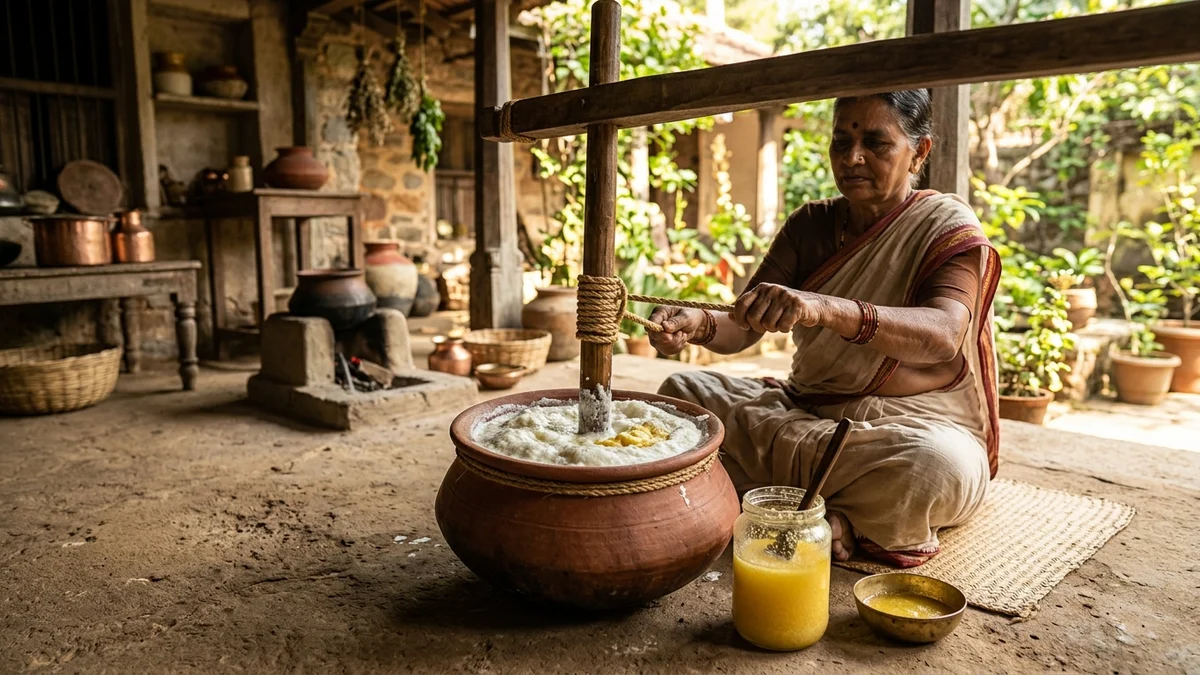
The word bilona refers to the traditional wooden churner used to churn cultured curd into fresh country butter.
Unlike factory ghee, true bilona ghee adheres strictly to the ancient 5-step Vedic method known as Pancha Samskara.
First, fresh cow milk is brought to a gentle boil and cooled naturally to room temperature.
Second, a live starter culture is added to ferment the entire volume of milk into thick, nutrient-rich whole curd.
Third, the whole curd is churned bi-directionally with a wooden churning staff until pristine butterfat (makkhan) rises to the surface.
Fourth, the cultured butter is separated by hand, leaving behind fresh probiotic buttermilk.
Fifth, the makkhan is transferred into an open vessel and slowly simmered on a very low flame.
As moisture evaporates, milk proteins brown gently at the bottom, releasing golden clarified butterfat with an exquisite granular texture.
Direct Comparison: Bilona Ghee vs Regular Ghee
To make the differences immediately obvious, here is how authentic bilona ghee compares against factory-produced regular ghee:
| Feature | Traditional Bilona Cow Ghee | Regular Commercial Ghee |
|---|---|---|
| Raw Material | Whole milk cultured into whole curd | Industrial raw cream (malai) |
| Extraction Method | Two-way wooden churning (bilona) | Motorized centrifugal cream separators |
| Fermentation | Yes (natural live bacterial culture) | None (unfermented dairy fat) |
| Cooking Heat | Slow, patient simmering on low flame | Flash industrial boiling at high pressure |
| Texture | Naturally granular (Danedar crystals) | Often greasy, pasty, or artificially uniform |
| Aroma Profile | Rich, nutty, deeply comforting | Mild, flat, or synthetic aroma enhancers |
| Butyric Acid Level | Very high (promotes gut lining repair) | Significantly lower due to high heat |
| Digestibility | Extremely light and easy on the gut | Heavier; may trigger dairy sensitivities |
| Milk Required / Yield | 25 to 30 litres per 1 kg of ghee | 12 to 14 litres of cream per kg |
The 7 Critical Differences Explained
1. Raw Material: Whole Curd vs Raw Cream
Commercial dairy processors do not culture milk into curd because it requires extra time, storage tanks, and labor.
Instead, they pass chilled milk through centrifugal separators to strip out industrial raw cream (malai) instantly.
In sharp contrast, bilona ghee starts with whole milk cultured overnight with beneficial lactobacillus strains.
This bacterial fermentation breaks down complex fats and infuses the butterfat with essential organic acids.
2. Natural Elimination of Lactose and Casein
Many people believe they are allergic to all dairy products when their bodies simply struggle with lactose sugar or casein proteins.
During traditional bilona culturing, active microbes consume nearly all residual lactose during fermentation.
The subsequent slow simmer causes casein and whey proteins to precipitate as golden curds, which are completely strained away.
The end result is 100% pure milk fat that can be safely enjoyed even by people with dairy sensitivities.
3. Gentle Low-Heat Cooking vs Industrial High-Heat Boiling
Industrial factories rely on high-pressure steam boilers reaching temperatures exceeding 130°C to melt mass batches rapidly.
Subjecting delicate dairy fats to sudden intense heat denatures delicate enzymes and destroys natural antioxidants.
Bilona ghee makers simmer the butter slowly over gentle, steady heat in traditional open pans.
This gentle boiling preserves the natural structure of healthy fats and allows genuine golden caramelization.
4. Naturally Granular (Danedar) Texture
Have you ever noticed that authentic ghee forms tiny crystalline granules as it cools at room temperature?
In Hindi and Tamil, this sought-after texture is called Danedar or Manal Manalaana Nei.
These granules develop naturally when diverse short, medium, and long-chain fatty acids crystallize at slightly different cooling rates.
Cream-based ghee often looks pasty, chalky, or greasy because rapid mechanical processing disrupts natural triglyceride crystallization.
5. Higher Concentrations of Butyric Acid
Butyric acid (butyrate) is a short-chain fatty acid that serves as the primary fuel source for cells lining your colon.
Because bilona ghee undergoes bacterial curd fermentation, its natural butyrate profile is substantially higher than uncultured butter.
Clinical studies demonstrate that butyrate reduces intestinal inflammation, supports a healthy gut barrier, and aids digestion.
Regular commercial cream ghee retains only modest levels of butyrate after industrial heat treatments.
6. Bioavailable Fat-Soluble Vitamins (A, D, E, K2)
True cow ghee is a potent natural delivery vehicle for vitamins A, D, E, and K2.
Vitamin K2 in particular helps guide calcium into bones and teeth rather than allowing it to calcify in arterial walls.
These essential micronutrients are fat-soluble, meaning your body cannot absorb them efficiently without healthy lipids.
When ghee is extracted gently without chemical bleaching or de-gumming, these vital micronutrients remain intact and bioavailable.
7. Pure Aroma Free from Artificial Flavorings
Open a jar of authentic bilona cow ghee, and your kitchen fills with a warm, comforting, slightly nutty aroma.
This fragrance is the natural byproduct of caramelized milk solids interacting with cultured butterfat over hours of gentle simmering.
Because industrial ghee lacks this slow caramelization, some commercial brands add synthetic butter flavorings such as ethyl butyrate.
Authentic bilona ghee needs no synthetic help: its aroma is 100% natural and unmistakable.
Hasta Pure Cow Ghee (1 Litre Pantry Jar)
Handcrafted in small batches, 100% milk fat, certified NABL lab tested, and packed in glass. Includes free shipping across India plus a complimentary handcrafted neem wood spatula.
Proven Health & Nutritional Benefits
In traditional Ayurvedic medicine, cow ghee is celebrated as a premier Rasayana (rejuvenating tonic) and Yogavahi (catalytic agent).
Modern nutritional science increasingly validates these ancient observations across several key dimensions:
- Strengthens the Gut Lining: High natural concentrations of butyrate fuel the intestinal epithelial cells, helping soothe leaky gut and reduce chronic inflammation.
- Enhances Nutrient Bioavailability: Cooking spices such as turmeric, black pepper, and cumin in ghee helps your body absorb fat-soluble curcumin by over 2,000%.
- Supports Healthy Cholesterol Metabolism: Cow ghee contains medium-chain triglycerides (MCTs) that metabolize directly in the liver for clean energy rather than being deposited as adipose tissue.
- Joint Lubrication and Flexibility: Natural healthy lipids nourish connective tissues and support fluid joint movement, making it particularly beneficial for seniors and athletes.
- Cognitive Support: Traditional wisdom recommends a morning spoonful of warm cow ghee to nourish brain cells, enhance memory retention, and soothe the nervous system.
Cooking Stability and High Smoke Points
One of the greatest dangers of modern cooking is the use of refined seed oils that oxidize when exposed to high heat.
When vegetable oils such as sunflower or soybean oil smoke, they break down into toxic lipid peroxides and aldehydes.
Pure cow ghee has an exceptionally high smoke point of 250°C (482°F), well above butter (175°C) or extra virgin olive oil (190°C).
Because all volatile milk solids and water have been simmered away, ghee withstands deep tadkas, roasting, and sauteing without degrading.
This heat stability makes it the safest, healthiest cooking medium for everyday Indian kitchens.
5 Simple Tests to Check Ghee Purity at Home
Because cow ghee commands a premium price, adulteration with palm oil, animal tallow, or hydrogenated vegetable fats (vanaspati) is unfortunately common.
Here are 5 simple, dependable tests you can conduct in your kitchen without any specialized equipment:
Place a teaspoon of ghee into a pan on gentle heat. Pure cow ghee melts almost immediately and turns a clear, rich brownish-gold. Adulterated ghee takes much longer to melt and turns into a dull yellowish-white puddle.
Put a small dab of solid ghee onto your palm. Because pure milk fat has a melting point close to normal human body temperature (37°C), genuine ghee will begin melting within seconds simply from your skin warmth. Ghee adulterated with vanaspati or wax remains solid and sticky.
Melt two teaspoons of ghee and add two drops of medical iodine solution. If the mixture turns blue or purple, starch (such as boiled mashed potato or flour) has been added as a cheap bulking agent. Pure ghee remains unaffected.
Melt a small sample in a clear glass bottle and place it in the refrigerator for two hours. Pure cow ghee will solidify into a single, uniform golden crystalline layer. Adulterated ghee often separates into distinct stratified layers with differing colors.
Warm a spoonful in a glass jar. Genuine bilona ghee gives off a deep, comforting, toasted nutty fragrance that lingers pleasantly. Chemically deodorized or blended ghee smells flat, faintly waxy, or like artificial movie-theater popcorn flavoring.
What NABL Laboratory Tests Actually Measure
While kitchen tests offer quick assurance, professional laboratory testing provides definitive biochemical proof of authenticity.
At Hasta Foods, our ghee is regularly analyzed through NABL-accredited laboratories against strict national food safety parameters:
- Reichert-Meissl (RM) Value: Measures volatile soluble fatty acids. Pure cow ghee must maintain an RM value between 26 and 32. Lower scores reveal adulteration with palm oil, animal fats, or paraffin.
- Moisture Content: Must remain strictly under 0.3%. Moisture above 0.3% allows microbes to grow and causes rancidity.
- Free Fatty Acid (FFA) as Oleic Acid: Measures hydrolytic rancidity. Fresh, pure ghee maintains an FFA under 1.0%, confirming fresh milk handling.
- Baudouin and Halphen Tests: Chemical assays that immediately confirm the absolute absence of sesame oil, cottonseed oil, and hydrogenated vegetable fats.
Every batch sealed in our kitchen carries the FSSAI quality mark and meets these rigorous laboratory benchmarks before dispatch.
How to Choose the Right Jar for Your Home
When selecting ghee for your family, always inspect three essential packaging details:
First, read the ingredient list: it must state 100% Pure Milk Fat with absolutely zero preservatives, colors, or artificial flavorings.
Second, insist on food-grade glass jar packaging rather than plastic containers to prevent phthalates and microplastics from leaching into the fat.
Third, choose a pack size that fits your family's cooking volume:
Fresh Single-Source Pure Cow Ghee in Glass Jars
Sealed in protective food-grade glass jars with NABL-verified purity and zero synthetic chemicals.
Best value for regular family cooking, daily tadkas, and Ayurvedic wellness. Lowest price per 100ml.
Most popular everyday jar for smaller households, rotis, rice, and fresh baby food preparation.
Available in 250ml starter jar (₹499) for trial testing, or 750ml family jar (₹1,199 with Free Spatula).
Frequently Asked Questions
What is the main difference between bilona ghee and regular ghee?
The main difference lies in the starting ingredient and method. Bilona ghee is prepared by culturing whole cow milk into curd and churning it with a wooden churner to harvest makkhan before slow simmering. Regular ghee is made by separating industrial milk cream in centrifugal machines and boiling it quickly at high heat.
Why does bilona cow ghee cost more than commercial ghee?
Making 1 litre of authentic bilona ghee requires approximately 25 to 30 litres of whole cow milk, natural curd culturing, and hours of patient low-flame boiling. Regular commercial cream ghee requires only about 12 to 14 litres of cream separated via high-speed machinery, resulting in much higher factory yields at lower cost.
Is bilona ghee safe for people with lactose intolerance?
Yes. During natural curd culturing and subsequent slow boiling, milk solids, lactose, and casein separate and are strained away. Laboratory tested pure cow ghee contains zero measurable lactose, making it easily digestible for lactose-sensitive individuals.
How can I tell if my ghee has been adulterated with vegetable oil or palm oil?
A quick spoon melt test is very reliable. Real cow ghee melts almost instantly into a translucent golden liquid over gentle heat. Ghee adulterated with palm oil or hydrogenated fats takes much longer to melt and leaves a cloudy, greasy yellowish-white film.
Does authentic bilona ghee require refrigeration after opening?
No. Properly prepared bilona cow ghee has a moisture content below 0.3%, preventing bacterial growth. Store it in a clean, airtight glass jar at room temperature away from direct sunlight, and always use a clean, dry wooden or steel spoon.
Conclusion: Invest in Real Food Integrity
Ghee is not merely a cooking oil; it is a sacred nourishing food that sustains your family's vitality from within.
While commercial cream-separated ghee may be cheaper and faster to produce, it cannot match the biological richness, gut-healing butyrate, and exquisite aroma of patient, cultured bilona cow ghee.
When you choose authentic ghee crafted from cultured curd, you honor traditional agricultural wisdom and give your body the purest nutrition nature can offer.

Sivaranjini M
Third Generation StewardSivaranjini is the third-generation steward of Hasta Foods in Madurai. She oversees authentic ghee making, preserving traditional kitchen practices while maintaining rigorous laboratory food standards.

Harish
Quality & Operations LeadHarish oversees batch testing, NABL laboratory parameters, and dispatch fulfillment at Hasta Foods. He verifies batch quality before jars are sealed for delivery.