
How to Test Ghee Purity at Home: 5 Reliable Kitchen Tests and What NABL Laboratory Reports Actually Mean
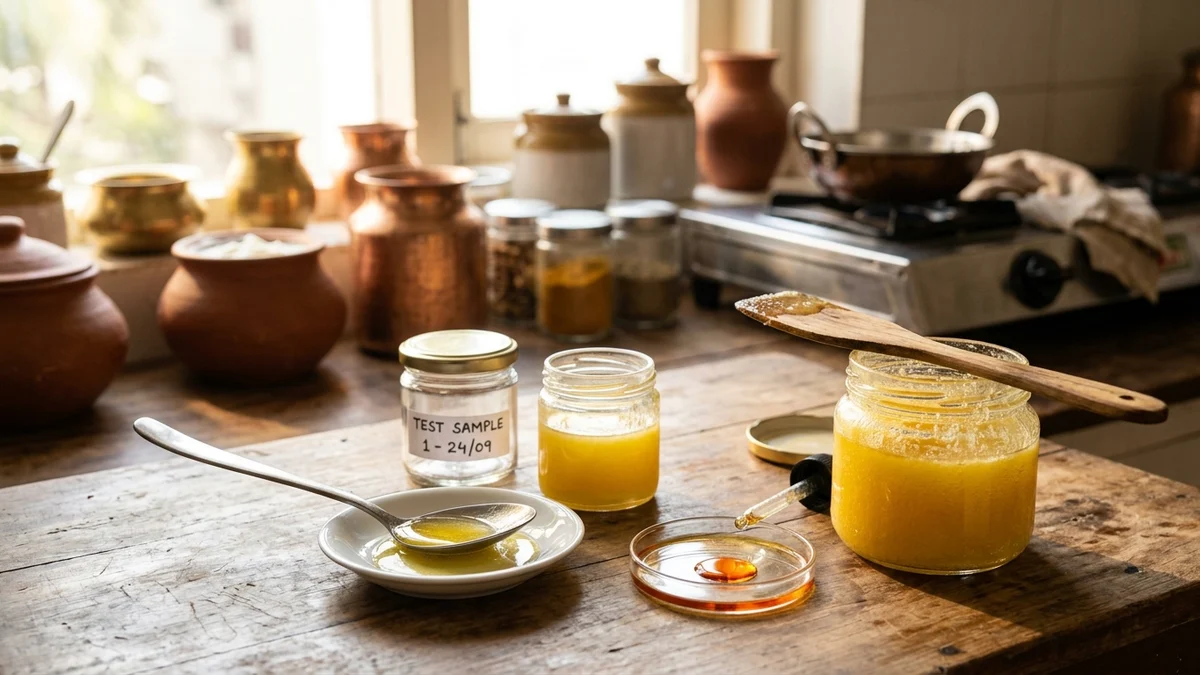
✨ Key Takeaways for Quick Reading
- Commercial ghee adulteration frequently relies on palm olein, hydrogenated vanaspati, animal tallow, or starch to inflate volume and profit margins.
- Simple kitchen tests like the spoon heat melt test, palm melt test, and iodine starch test give immediate preliminary clues on purity.
- Kitchen tests cannot detect sophisticated partial adulteration or quantify fatty acid profiles; conclusive verification requires NABL accredited laboratory analysis.
- The Reichert-Meissl (RM) value is the decisive test for dairy fat: authentic cow ghee registers between 26 and 32, whereas vegetable oils register near zero.
- Choosing ghee packaged in food-grade glass with batch-level NABL testing ensures complete freedom from trans-fats, adulterants, and plastic leaching.
Pure cow ghee has been revered across India as liquid gold for thousands of years.
It enriches daily meals, fuels digestive fires, and nourishes growing children.
Yet in modern supermarkets, ghee has become one of the most frequently adulterated food products on the shelf.
Learning how to spot imitation fats at home and reading authentic laboratory reports is essential for protecting your family.
Why Ghee Adulteration Happens in Modern Markets
The primary driver of ghee adulteration is simple mathematics and profit margins.
Crafting one single kilogram of genuine cow ghee requires 25 to 30 litres of wholesome cow milk.
When factoring in village dairy collection, milk testing, and slow firewood simmering, authentic ghee carries a real production cost.
In contrast, industrial palm olein, vegetable oils, and hydrogenated fats cost a tiny fraction of that amount.
Unscrupulous commercial processors blend cheap vegetable fats into milk fat to double or triple their profits.
To disguise the dilution, they add synthetic coloring agents, yellow dyes, and chemical butter fragrances.
Common Ghee Adulterants: Palm Oil, Vanaspati, and Starch
Modern food adulteration has evolved from crude kitchen tricks into sophisticated industrial blending.
Understanding the specific substances blended into commercial ghee helps you know what tests to apply.
1. Refined Palm Olein and Fractionated Palm Stearin
Palm oil is the most widespread adulterant in cheap commercial ghee across urban markets.
It is virtually odorless when heavily refined, neutral in taste, and extremely cheap in bulk quantities.
When blended up to 20% by volume, palm olein remains molten alongside liquid ghee, making visual detection difficult at room temperature.
2. Vanaspati and Hydrogenated Vegetable Oils
Vanaspati is partially hydrogenated vegetable oil loaded with artificial trans-fatty acids.
Manufacturers mix vanaspati because its solidified texture can mimic the granular look of traditional ghee.
Consuming hidden vanaspati damages cardiovascular health and raises systemic inflammatory markers over time.
3. Starches, Mashed Potatoes, and Flours
In local unorganized sweet shops and street markets, starches are often blended into loose ghee.
Boiled mashed potatoes, sweet potatoes, and corn starch are whipped into warm butter to artificially increase weight.
Fortunately, starch adulteration is among the easiest contaminants to detect using basic household chemistry.
4. Animal Tallow and Slaughterhouse Body Fats
In illicit food operations, industrial animal tallow is melted and bleached to dilute dairy fats.
This practice violates religious dietary laws and poses serious microbiological hazards to consumers.
Detecting tallow requires professional laboratory chromatography, as its physical consistency mimics dairy fat closely.
5 Reliable Kitchen Tests You Can Do Right Now
While home tests cannot replace an ISO accredited laboratory, they provide an immediate first line of defense.
You can conduct these five practical tests on your kitchen counter using common everyday tools.
Test 1: The Spoon Heat and Caramelization Test
This is the fastest and most revealing preliminary test for testing melting kinetics and fat purity.
How to perform it: Place one teaspoon of ghee onto a stainless steel spoon or small pan and hold it over a medium gas flame.
What happens with pure ghee: Pure cow ghee melts almost instantly, within two to three seconds.
As heat increases, it quickly darkens into a clear, reddish-brown caramel color and releases a pleasant nutty aroma.
What happens with adulterated ghee: Ghee mixed with palm oil or vanaspati takes considerably longer to liquefy.
Instead of turning a rich caramel brown, it remains a pale or dull yellow liquid and produces a faint greasy smell.
Test 2: The Palm Melt Test (Body Temperature Response)
Pure cow milk fat has an exceptionally narrow melting point between 32 and 35 degrees Celsius.
Because normal human body temperature is around 37 degrees Celsius, genuine cow ghee responds immediately to bodily warmth.
How to perform it: Place a small half-spoon dab of semi-solid ghee onto the clean palm of your hand.
What happens with pure ghee: Genuine ghee begins melting on skin contact within 10 to 20 seconds.
It turns into a soothing, silky golden liquid without leaving any sticky, wax-like residue on your skin.
What happens with adulterated ghee: Hydrogenated fats and palm stearin melt at higher temperatures (38 to 44 degrees Celsius).
The sample remains stubborn and lumpy on your palm, feeling like cosmetic wax rather than edible food fat.
Test 3: The Iodine / Betadine Starch Test
This chemical reaction is 100% conclusive for spotting added starches, potatoes, or flour binders.
How to perform it: Melt two teaspoons of ghee in a clean glass bowl and let it cool slightly.
Add two to three drops of household tincture of iodine or Betadine solution to the liquid fat and stir gently.
What happens with pure ghee: The brown iodine droplet stays separate or disperses without altering the golden color of the ghee.
What happens with adulterated ghee: If any starch is present, the mixture immediately turns dark purple, deep blue, or black.
This instant color change occurs because iodine binds directly with amylose molecules inside starch polymers.
Test 4: The Double-Boiler and Refrigerator Layering Test
Commercial blenders frequently mix oils with different specific gravities and freezing profiles.
How to perform it: Melt a sample of ghee completely inside a transparent glass vial or drinking glass.
Place the glass into your refrigerator for approximately two to three hours until completely solid.
What happens with pure ghee: Pure cow ghee solidifies into a single, uniform, homogeneous block of fat.
The entire column retains a consistent golden-amber hue from top to bottom.
What happens with adulterated ghee: If multiple vegetable oils are blended, they separate into distinct horizontal strata.
You will observe clear visual bands: a cloudy dense layer at the base and a clear oily layer floating above.
Test 5: The Hot Water Dispersion and Scent Test
Synthetic aroma chemicals behave very differently in hot water compared to natural volatile fatty acids.
How to perform it: Pour half a cup of boiling water into a mug and drop in one teaspoon of ghee.
What happens with pure ghee: Pure ghee floats as a clean, shimmering golden lipid ring on the water surface.
The steam rising from the cup carries an authentic, sweet, butter-toasted fragrance that lingers gently.
What happens with adulterated ghee: Adulterated fat forms an opaque, whitish emulsion across the water.
The rising vapor smells artificial, chemical, or sour once the volatile synthetic aroma dissipates.
Kitchen Tests Summary: Steps, Results, and Accuracy
Here is a quick reference comparison summarizing all five home tests, their target adulterants, and their practical reliability:
| Test Name | Target Adulterant | Pure Ghee Reaction | Adulterated Reaction | Reliability |
|---|---|---|---|---|
| Spoon Heat Test | Palm oil, vanaspati | Melts in 2-3 sec, browns to rich caramel | Melts slowly, stays pale yellow | High (Preliminary) |
| Palm Melt Test | High-melting vegetable waxes | Liquefies rapidly at skin temperature | Remains solid, leaves waxy film | Moderate |
| Iodine Test | Starch, mashed potatoes, flours | No color change; golden tint remains | Turns dark blue, purple, or black | 100% for Starch |
| Refrigerator Test | Blended vegetable oils | Solidifies into one uniform single layer | Separates into visible horizontal layers | High |
| Hot Water Dispersion | Synthetic fragrances, detergents | Clear lipid ring with sweet butter steam | Cloudy emulsion, unpleasant odor | Moderate |
The Critical Limitations of Home Testing
While kitchen tests are empowering, honest food science requires understanding their boundaries.
Modern commercial adulteration has become remarkably clever and technologically advanced.
When an adulterer blends 5% or 10% highly refined palm olein into real butterfat, visual tests rarely reveal the difference.
Furthermore, crude home tests cannot quantify free fatty acid values, oxidation peroxide levels, or heavy metal residues.
Nor can kitchen tests confirm whether a jar contains cultured bilona cow ghee or factory cream ghee.
This is precisely why professional NABL laboratory testing standards exist in the formal food system.
Decoding NABL Laboratory Reports: The 5 Decisive Tests
When reviewing an official Certificate of Analysis from a NABL laboratory, look for these five crucial parameters:
1. The Reichert-Meissl (RM) Value
The RM value is the gold standard indicator for confirming authentic ruminant milk fat.
It measures the quantity of volatile, steam-distillable, water-soluble fatty acids, principally butyric and caproic acid.
These short-chain fatty acids occur naturally in ruminant milk fat but are virtually absent in vegetable oils and body fats.
FSSAI mandates that pure cow ghee maintain an RM value of at least 26.0 (or 28.0 depending on the region).
Vegetable oils register an RM value of 0.1 to 0.5; any reading below 26 immediately signals foreign fat dilution.
2. The Baudouin Test (Detection of Vanaspati)
By Indian law, all hydrogenated vegetable oil (vanaspati) must contain 5% sesame oil as a chemical tracer.
The Baudouin test mixes concentrated hydrochloric acid and furfural solution with the melted fat sample.
If sesame oil is present, the acid layer turns a vivid pink or crimson red within minutes.
A negative Baudouin test proves zero hydrogenated vanaspati is blended into the product.
3. Butyro-Refractometer (BR) Reading at 40 Degrees Celsius
The BR reading measures the refractive index of light passing through liquid butterfat at a standardized temperature.
Pure cow ghee must read strictly between 40.0 and 43.0 on the refractometer scale.
Most vegetable oils have significantly higher refractive indices (45 to 55).
A BR reading above 43.5 indicates that unsaturated foreign plant oils have been introduced.
4. Free Fatty Acid (FFA) Percentage as Oleic Acid
FFA content is the primary indicator of milk freshness, processing cleanliness, and storage hygiene.
When butterfat breaks down through moisture hydrolysis or bacterial spoilage, free fatty acids are released.
FSSAI establishes a legal upper ceiling of 3.0% maximum FFA for marketable ghee.
Premium small-batch ghee crafted from fresh farm milk consistently registers well below 1.0% FFA, ensuring long natural shelf life.
5. Moisture Content by Mass
Moisture is the single greatest enemy of ghee stability, because water molecules support fungal and microbial growth.
Proper slow boiling evaporates all residual water, ensuring the finished moisture level stays under 0.3% by weight.
A moisture level below 0.3% allows pure ghee to stay naturally stable at room temperature without synthetic preservatives.
FSSAI Ghee Quality Benchmark Standards
Compare the statutory food safety benchmarks against what adulterated samples and premium artisanal ghee show:
| Laboratory Parameter | FSSAI Mandate | Typical Adulterated Value | Hasta Foods Standard |
|---|---|---|---|
| Reichert-Meissl (RM) Value | Min 26.0 (or 28.0) | Below 22.0 (often 8 - 14) | 28.5 to 31.5 |
| BR Reading at 40°C | 40.0 to 43.0 | Above 44.5 | 41.0 to 42.0 |
| Baudouin Test (Vanaspati) | Must be Negative | Positive (turns crimson) | Negative (Pass) |
| Free Fatty Acids (as Oleic) | Max 3.0% | Above 2.5% (stale fat) | Under 0.8% (Ultra Fresh) |
| Moisture Content | Max 0.5% | 0.6% to 1.2% | Under 0.25% |
| Added Preservatives / Colors | Nil | Beta-carotene, synthetic aromas | 100% Zero Additives |
How to Choose Guaranteed Pure Ghee for Your Home
Testing at home gives peace of mind, but choosing a producer with rigorous batch standards removes the guesswork entirely.
Look for brands that pack exclusively in food-grade glass jars and share verifiable laboratory certifications.
Glass preserves the delicate aromas and volatile fatty acids without leaching plasticizers or microplastics into your food.
Fresh Single-Source Pure Cow Ghee in Glass Jars
Sealed in protective food-grade glass jars with NABL-verified purity and zero synthetic chemicals.
Best value for regular family cooking, daily tadkas, and Ayurvedic wellness. Lowest price per 100ml.
Most popular everyday jar for smaller households, rotis, rice, and fresh baby food preparation.
Available in 250ml starter jar (₹499) for trial testing, or 750ml family jar (₹1,199 with Free Spatula).
Frequently Asked Questions
Can a simple home test detect 100% of ghee adulterants?
No. While home tests like the spoon heat test or iodine test easily expose crude adulterants like starch and unrefined palm oil, modern industrial adulteration blends deodorized fats that mimic melting points closely. Only an accredited NABL laboratory testing RM value and fatty acid profiles can provide definitive proof.
What does a high Reichert-Meissl (RM) value mean in ghee?
The RM value measures volatile soluble fatty acids like butyric and caproic acid that are unique to ruminant milk fat. Pure cow ghee typically records an RM value between 26 and 32. Vegetable oils and animal body fats register RM values close to zero. Any reading below 26 strongly suggests adulteration.
Why does pure cow ghee turn brown quickly when heated?
Pure cow ghee has a natural burning threshold of around 250 degrees Celsius (482 degrees Fahrenheit). Under direct high flame, pure milk fat melts immediately and browns within seconds due to caramelization of micro-traces of milk fat sugars. Adulterated ghee full of high-boiling vegetable fats takes significantly longer to melt and stays dull yellow.
Is grainy (danedar) texture a guarantee of purity?
Granular texture indicates proper slow cooling of genuine milk fat crystals, which is a wonderful physical hallmark of traditional bilona ghee. However, manufacturers can artificially simulate grains using chilled hydrogenated fats (vanaspati). Granulation must always be evaluated alongside natural aroma and heat performance.
What is the Baudouin test and why is it important?
The Baudouin test is a chemical test using hydrochloric acid and furfural solution to detect sesame oil, which is legally mandated in India to be added to vanaspati. If ghee turns pink or crimson during this test, it confirms the presence of hydrogenated vegetable fats.
Conclusion: Protect Your Health with Verifiable Quality
Ghee is a staple of everyday nourishment, Ayurvedic healing, and celebratory cooking across Indian homes.
With adulteration risks rising in mass commercial supply chains, knowing how to verify purity is your strongest safeguard.
Use simple kitchen tests for preliminary checks, but always trust verified NABL laboratory parameters and glass packaging for lasting peace of mind.
When food integrity comes first, every spoonful delivers the authentic vitality, golden aroma, and nourishment that nature intended.

Sivaranjini M
Third Generation StewardSivaranjini is the third-generation steward of Hasta Foods in Madurai. She oversees authentic ghee making, preserving traditional kitchen practices while maintaining rigorous laboratory food standards.

Harish
Quality & Operations LeadHarish oversees batch testing, NABL laboratory parameters, and dispatch fulfillment at Hasta Foods. He verifies batch quality before jars are sealed for delivery.